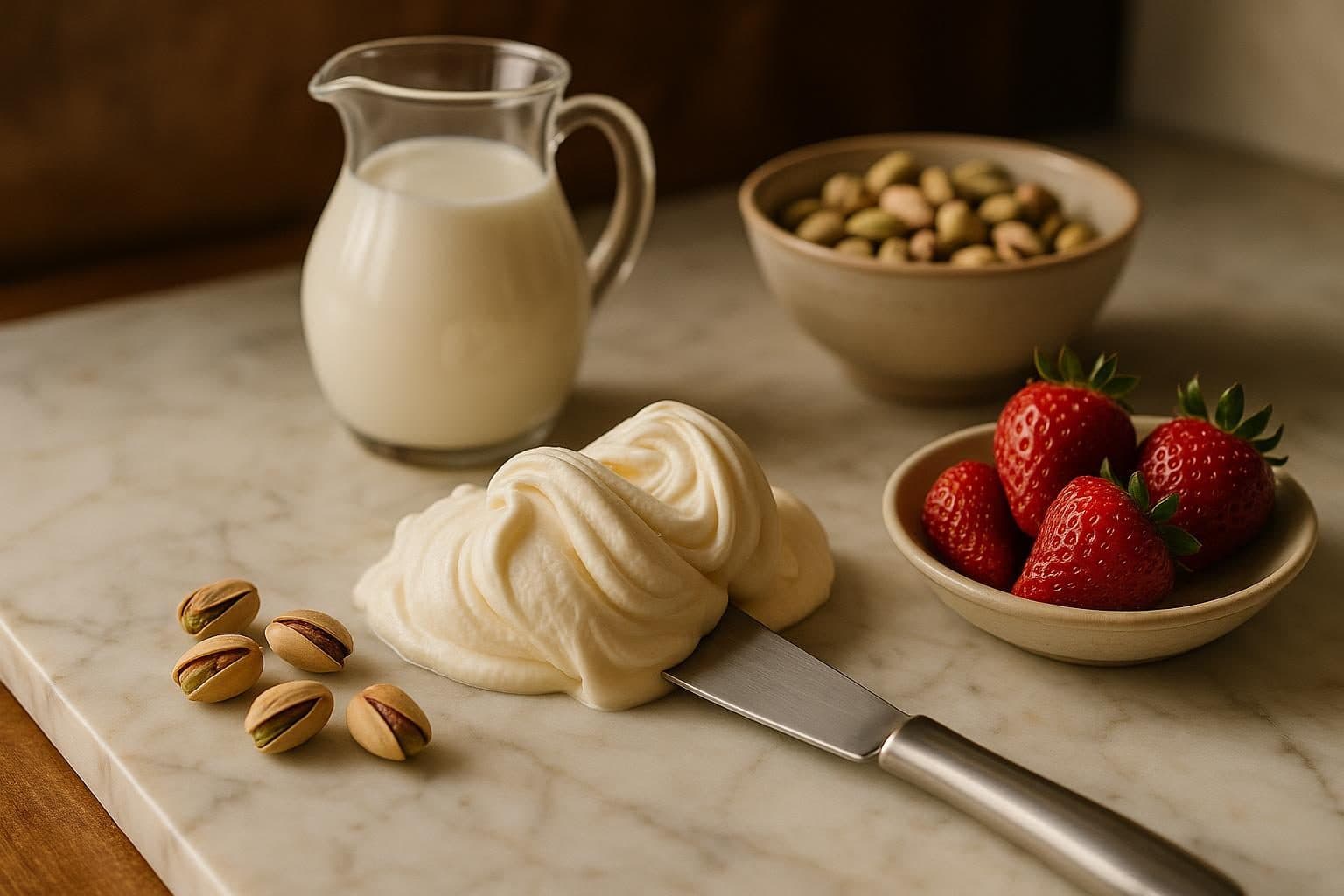
Three names appear again and again on labels: palm oil, hydrogenated fats and glucose-fructose syrup. You won't find them in our products. Here's why.
Do you read the ingredients of the products you buy? If you do, you've probably noticed three names that appear again and again: palm oil, partially hydrogenated fats and glucose-fructose syrup. You won't find them in our products. Here's why.
Palm oil — cheap, but at what cost?
Palm oil is the most mass-produced vegetable oil in the world. It's cheap, stable at high temperatures and gives a creamy texture and long shelf life. That's why it's used in over 50% of packaged foods in supermarkets — from biscuits to chocolate, from ice cream to margarine. But behind that efficiency lie three serious problems.
The health aspect: palm oil contains around 50% saturated fatty acids — mainly palmitic acid. Numerous studies link excessive saturated-fat consumption with a higher risk of cardiovascular disease; the WHO recommends limiting it to under 10% of daily calories. Moreover, refining at high temperatures forms contaminants — glycidyl esters and 3-MCPD — classified by EFSA as potentially carcinogenic.
The environmental aspect: palm oil production is among the main drivers of deforestation in Malaysia and Indonesia — the two countries supplying over 85% of world output. The rainforests cleared for plantations are home to orangutans, Sumatran tigers and hundreds of endangered species, and burning the forests releases enormous amounts of carbon dioxide.
The flavour aspect: palm oil masks taste. It's neutral, without character — exactly why it's so convenient for industry. But that very neutrality is the problem for an artisan maker. We use butter, cocoa butter and ghee — each with its own character, aroma and depth. In our products the fat has a taste, because it comes from somewhere: from a cow, from a cocoa tree, from tradition.
Hydrogenated fats — the story of trans fats
Hydrogenation is an industrial process in which liquid vegetable oil is turned into a solid fat by adding hydrogen under pressure. The result is a cheap, stable fat with a long shelf life — ideal for industry. But partially hydrogenated fats contain trans fatty acids, and those are the problem.
- They raise LDL ('bad') cholesterol and lower HDL ('good') — a double danger for the heart.
- They increase the risk of heart attack and stroke — up to 21% higher risk of heart disease.
- They trigger systemic inflammation — linked to type 2 diabetes, cancer and neurodegenerative disease.
- They have no 'safe' dose — the WHO recommends eliminating them entirely from the food chain.
Regulation in Europe
Since 2021 the EU has capped the maximum content of trans fats in food at 2 g per 100 g of fat. Several countries — Denmark, Austria, Hungary — banned them outright years before the European regulation. The result in Denmark: a significant drop in cardiovascular mortality within 10 years of the ban.
Partially hydrogenated fats are now significantly restricted in the EU. But 'fully hydrogenated' ones — free of trans fats, yet still carrying the problems of saturated fat — are still used widely. You won't find them in our products.
Instead of hydrogenated fats, we use natural alternatives — each with a clear origin and an established role:
| Instead of | We use | Why |
|---|---|---|
| Hydrogenated fats | Butter, 82% | Natural, flavourful, no trans fats |
| Palm oil | Cocoa butter | 100% from the cocoa tree — stable and aromatic |
| Vegetable fat | Ghee | Clarified butter — no water, rich aroma |
Glucose-fructose syrup — the sugar that doesn't look like sugar
Glucose-fructose syrup (GFS) is a liquid sweetener made from corn starch through enzymatic processes. It's cheaper than sucrose, sweeter, easier to dissolve and extends shelf life. That's why industry loves it — and why we avoid it.
Fructose is metabolised differently. Glucose is broken down by every cell in the body, while free fructose — as found in GFS — is metabolised almost entirely in the liver. At high intake the liver turns it into fat, which leads to:
- Non-alcoholic fatty liver disease (NAFLD) — rising alarmingly in developed countries.
- Raised blood triglyceride levels.
- Insulin resistance — a precursor to type 2 diabetes.
- Increased uric-acid production — linked to gout.
It sends no fullness signal. Sucrose stimulates insulin production, which in turn stimulates leptin — the satiety hormone. Free fructose doesn't trigger this chain. The result: you can consume significant amounts of GFS without your brain receiving a fullness signal — which is why products with GFS are so easy to overeat.
And it's everywhere. GFS turns up in soft drinks, fruit juices, ketchup, dressings, bread, biscuits, cakes, ice cream, jams and bars. When it's in almost everything, even moderate consumption of a single product adds up to a significant cumulative intake.
Our alternative
In our products we use natural sugars, each with a specific role and a clear origin:
| We use | Origin | Role |
|---|---|---|
| Sucrose (white sugar) | Cane / beet sugar | The base — in moderate amounts |
| Dextrose | Starch | Less sweet — less sugar for the same effect |
| Glucose DE40 | Starch | Anti-crystalliser, softness of texture |
| Invert sugar | Sucrose + enzymes | 120% sweetness — so a smaller amount is needed |
| Natural fruit sugars | Fresh fruit | The main flavour contribution — with fibre, vitamins and aromas |
Our philosophy — read the ingredients
The choice not to use palm oil, hydrogenated fats and glucose-fructose syrup is not a marketing decision. It precedes any marketing. It's a philosophical and ethical decision — about what we stand for, what we make, and who we offer it to.
These three ingredients are cheap. Their absence from our products is more expensive. But the price of quality is different from the price of compromise — and we have chosen the former.
How to read labels — a short guide
Ingredients are listed by weight — from most to least. Here's what to watch for:
| Watch for | What it means |
|---|---|
| Palm oil | A cheap saturated fat with environmental and health questions |
| Partially hydrogenated oil | Contains trans fats — avoid! |
| Glucose-fructose syrup | Concentrated fructose — linked to metabolic problems |
| Vegetable fat (unspecified) | Probably palm — if it isn't specified, ask |
| Sugar as the 2nd or 3rd ingredient | The product is very high in sugar |
In our products you'll find butter, cocoa butter, ghee, cream, milk, fresh fruit and fruit purées, sugar, dextrose, glucose, invert sugar, eggs, chocolate, nut pastes, flour and sea salt. Everything with an origin, everything with a function, nothing hidden behind generic names. Transparency isn't hard when you have nothing to hide.
Ask us. If you have a question about an ingredient in a particular product — ask. We know what we put in and why. And we like it when customers care.
In the end
Choosing ingredients is choosing values. When you buy a product, you vote — with your money, your attention, your choice — for the kind of production you want to exist. Every product whose ingredient list is free of palm oil, hydrogenated fats and GFS is a small victory of quality over convenience.
We make the harder choice every day — more expensive ingredients, a shorter shelf life, more complex technology. We do it because we believe you have the right to a product made from real ingredients, by people who understand what they put inside. And because the taste of real butter, fresh fruit and quality chocolate is incomparably better than any imitation.
Read the ingredients. Ask questions. Choose with attention. Your taste will thank you.
- Why is palm oil so widespread?
- Because it's cheap, stable at high temperatures and extends shelf life. It's used in over 50% of packaged foods — but it has health, environmental and flavour drawbacks.
- Is the fructose in fruit harmful?
- No. The amount is small and the fibre slows absorption. The problem is free fructose in a concentrated, fibre-free syrup, which loads the liver directly.
- What do you use instead of these ingredients?
- Butter, cocoa butter and ghee instead of palm and hydrogenated fats; natural sugars and fruit instead of glucose-fructose syrup.