There's a difference between eating and tasting. Between swallowing and savouring. That difference is a culture of taste — and it isn't bought, it's cultivated.
There's a difference between eating and tasting. Between swallowing and savouring. Between a product made to be sold and a product made to be remembered. That difference is a culture of taste — and it isn't bought. It's cultivated.
How taste is born
Children are born preferring sweetness — evolution programmed our brain to seek sugar as a signal of energy and safety. But true, mature, conscious taste is not something we're born with. It's learned.
The first strawberry gelato you ate with your mother in the garden, on the square. The bitter dark chocolate that captivated you as a child and that you grew to love as an adult. The birthday cake that smells of childhood. Taste memories are among the most enduring, because aromas and flavours are processed directly by the limbic system — the centre of emotion and memory.
Learning to taste means learning to slow down. Letting the chocolate melt slowly on the tongue instead of chewing it. Noticing the acidity of raspberries beneath the sweetness of the cream. Sensing the salty note in caramel that makes everything else more intense. Taste isn't an instinct — it's a practice, like reading or playing an instrument.
The five dimensions of taste
Science recognises five basic tastes: sweet, sour, salty, bitter and umami. A masterful product isn't maximally sweet — it's balanced across all five.
| Taste | Its role | In our products |
|---|---|---|
| Sweet | Energy and pleasure; in excess it drowns out everything else | Sugar, glucose, fresh fruit — balanced, not maximised |
| Sour | Brings freshness and brightness; balances sweetness | Fresh raspberry, lemon, passion fruit — the acidity after the sweetness |
| Salty | Amplifies every other taste | Fleur de sel in the cream, sea salt in the caramel — invisible but indispensable |
| Bitter | Brings depth and complexity; a mark of maturity | Dark chocolate 65–70%, coffee, caramelised sugar |
| Umami | A sense of fullness and satisfaction | Ripe nuts, quality chocolate, long conching |
When you eat a chocolate bonbon and ask yourself why it's so good, the answer is almost never 'because it's sweet'. The answer is that it's balanced. The bitter shell, the creamy filling, the salty note, the fruity acidity — together they create something no single taste could achieve alone. Too sweet is forgotten. Balanced is remembered.
The craft behind the counter
When you see the case of gelato, the cakes behind the glass and the bonbons in their boxes, you see the final result. But behind every product is a process that began days earlier. Fresh fruit arrives in the morning and we check it — not only with our eyes, but with nose and mouth. We make gelato in small batches, because gelato made this morning is different from gelato made a week ago: fresher, more aromatic, more alive.
Small batches — the big difference
Industrial production works in thousands of litres and efficiency is maximal. But efficiency and freshness rarely go together. When you make 20 kg of gelato instead of 2,000 kg, you notice every variation — you sense when the purée is different and when the sugar should be reduced because the fruit is especially sweet this week.
Chocolate — the material that doesn't forgive
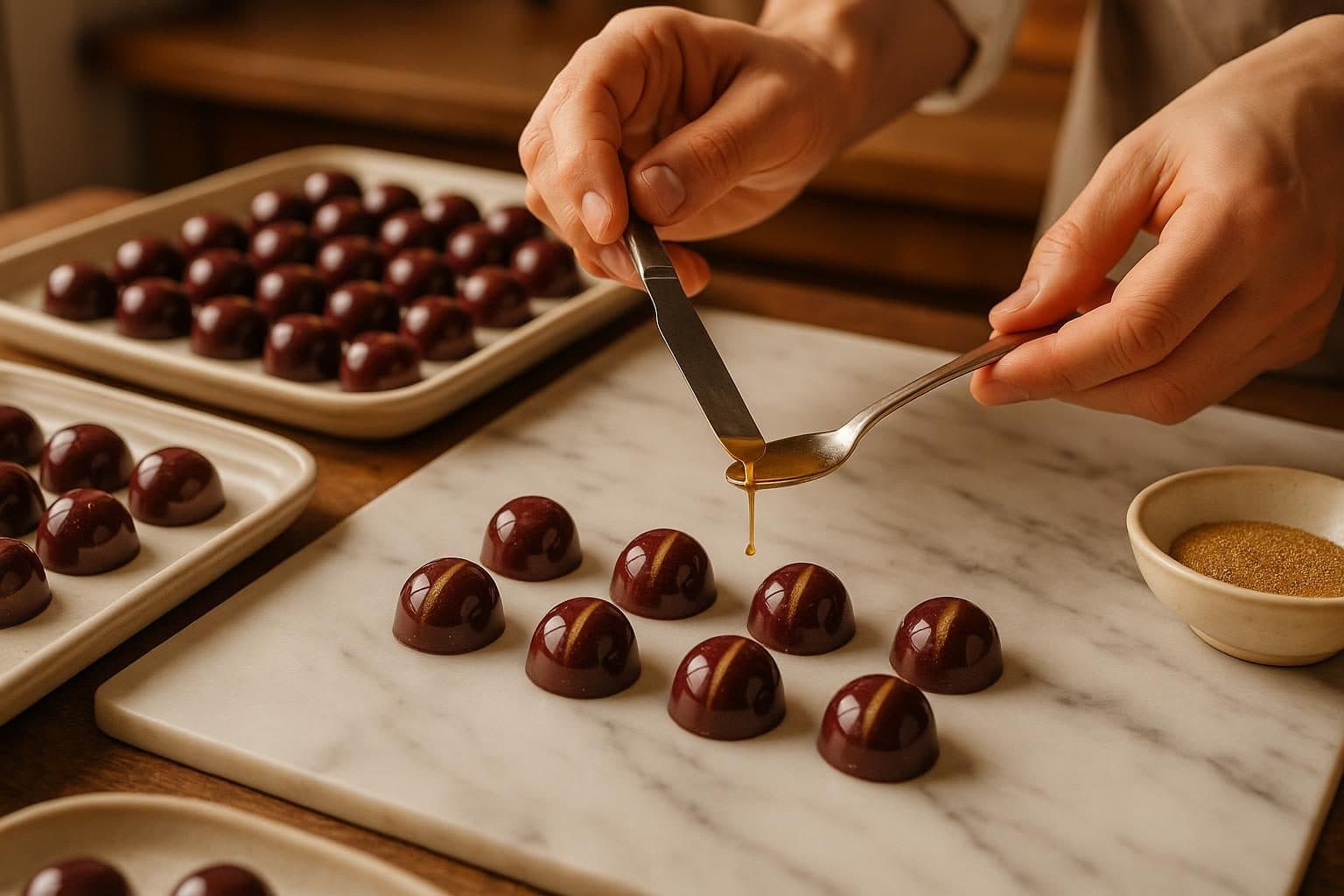
Tempering chocolate is perhaps the most eloquent example of the craft. Cocoa butter has six crystal forms; only one — Form V — gives that characteristic shine, the crisp snap and the slow melt right at body temperature. A two-degree error and the chocolate is dull and soft. The right temperature and you get a mirror-like surface and a sensation that lingers on the tongue seconds after the chocolate is gone.
How to cultivate taste — in yourself and in children
Taste is learned — and it's learned best through experience, attention and curiosity. Here are a few ideas, not only for you, but for the children in your life.
For yourself
- Eat slowly — give the brain time to process aroma, texture, temperature and taste.
- Compare — taste an industrial and an artisan chocolate side by side; the difference will be obvious.
- Don't fear bitterness — it's a sign of complexity.
- Seek out acidity — a good raspberry is both sweet and sour.
- Pay attention to salt — a pinch of sea salt amplifies everything around it.
For children
Children have more taste receptors than adults, so they're more sensitive to bitter and sour. But that's exactly why it matters to introduce them to the richness of flavour early, while they're still curious.
- Let them smell before they eat — aroma is 80% of taste.
- Don't hide the bitter — a little quality dark chocolate is a better taste education than a lot of milk chocolate.
- Shop together — let them choose and smell the fruit.
- Do something together in the kitchen — even just cracking eggs or stirring the cream.
- Talk about taste — 'Is it sweet? Is it sour? What else do you notice?'
A child taught to taste will seek quality, not quantity. And that may be the best gift we can give them.
Ideas for sweeter moments
| Idea | How |
|---|---|
| Gelato on a walk | Order a scoop of a flavour you've never tried and eat it slowly as you walk. |
| A chocolate tasting at home | Try milk, dark 54% and dark 70% in that order and notice how the bitterness at the end seems richer. |
| Cake for no reason | Surprise someone on an ordinary Tuesday — the effect is incomparable. |
| A bonbon with coffee | A dark bonbon with raspberry jelly and a good espresso — the bitter and the sour meet in the middle. |
| The seasonal flavour | Ask what's in season now — the ingredients are at their peak and the recipe is freshly adapted. |
In the end
Taste is a form of attention. To taste well means to be present — not only with your mouth, but with your nose, your eyes, your memory. It means appreciating the work that went into creating something good, and pausing, if only for a moment, before the small pleasure of the day.
We do what we do because we believe a world with more attention to the small things is a better world. The gelato, the cake, the bonbon aren't just food — they're an invitation to pause. To a conversation. To a moment when everything else disappears and only the taste remains.
Next time you hold something from our case, take a moment. Smell it. Wait for it to melt. Notice what happens after the first sensation. That's where the real story is.
Eat less, but better. Taste more slowly, but more deeply. And find a reason for sweet moments — even on an ordinary Tuesday.
- What does 'a culture of taste' mean?
- The ability to taste consciously — to slow down, notice the balance of sweet, sour, salty, bitter and umami, and appreciate quality. It's a skill cultivated through practice.
- Why do you make gelato in small batches?
- Because freshness matters. Gelato made this morning is more aromatic and alive, and small batches let us follow the season and adjust every recipe.
- How can I teach my child to appreciate taste?
- Let them smell food, don't hide bitter and sour flavours, shop together and talk about taste. Exposure and curiosity build a broad palate.