Bread, pasta, cheese, wine and olive oil — every day. They don't count calories or follow diets. Yet they live longer and healthier than almost any other nation. How?
In Sardinia, Greece, Southern Italy and Spain, people eat bread, pasta, cheese, wine and olive oil — sometimes every day. They don't count calories, follow diets or fear carbohydrates. And yet they live longer, healthier and with less excess weight than almost any other nation on earth. How is that possible?
The science behind Mediterranean longevity
Research began with the epidemiologist Ancel Keys in the mid-20th century, who noticed that the people of Crete and Southern Italy, despite their modest diet, had an exceptionally low rate of cardiovascular disease. Since then the Mediterranean diet has become perhaps the most studied eating pattern in medical history — and the results are consistent.
| Indicator | Reduction | Study / Note |
|---|---|---|
| Cardiovascular disease risk | up to 30% | PREDIMED, Spain (2013) |
| Type 2 diabetes risk | up to 52% | Meta-analysis of 19 studies |
| Dementia risk | up to 40% | University of Edinburgh (2015) |
| Cancer risk (overall) | up to 14% | European Prospective Investigation |
| Depression | up to 33% | UCL, London (2019) |
| Life expectancy | +3–5 years | Mediterranean vs Northern Europe |
What the Mediterranean diet actually is
The Mediterranean diet isn't a diet in the modern sense — a set of rules and prohibitions. It's a way of eating shaped over millennia by climate, geography and social life. If it had to be summed up in one sentence: lots of plant foods, quality fats, a moderate amount of protein, few processed products — and always in company.
| Food | How often & why |
|---|---|
| Olive oil | Daily — the main fat, rich in monounsaturated acids and polyphenols |
| Vegetables | Daily, every meal — tomato, aubergine, courgette, artichoke, olives |
| Fresh fruit | Daily — seasonal and local |
| Bread, pasta, rice | Daily, in moderation — no fear of carbohydrates |
| Legumes (lentils, chickpeas, beans) | Daily — a main protein, cheap and healthy |
| Fish & seafood | 2–4 times a week — the main animal protein |
| Cheese & yoghurt | Weekly — local and fermented, in moderation |
| Eggs | 3–4 times a week — not forbidden |
| Wine | A glass per meal — a social ritual, not abuse |
| Red meat | A few times a month — not at the centre |
| Sweets | When they're real — enjoyed fully, in small amounts |
Notice: nothing is forbidden. Everything is in context.
Taste is cultivated from an early age
Perhaps the most important difference between Mediterranean and Northern food cultures isn't what's eaten, but how the culture is passed from generation to generation. In Italy, Greece, Spain and France children don't eat 'children's food' — they sit at the table with the adults and eat the same: the bitter vegetables, the strong cheeses, the olives. The result is children whose palate is broad and needs no simplifying.
Science confirms the wisdom of the tradition. Taste preferences are largely formed in the first three years of life — through repetition and exposure. A child who has eaten bitter vegetables from an early age accepts them as normal; a child shielded from every 'unpleasant' taste develops a narrowed range of taste.
The table as ritual — not just eating
In Mediterranean countries the table isn't merely a place to obtain calories. It's a social ritual — with a fixed time, with presence, with conversation. In Italy the lunch break is even written into labour law; eating quickly at a desk isn't the norm but an exception people apologise for. Children raised at this table learn something no diet book can convey: eating is a shared experience.
Why they follow no diet fads
When you have a food identity — when you know what you eat, where it comes from and why it's good — you don't need a diet system. Diet fads thrive where that identity is missing, where the connection to food has been lost or never built.
An Italian who grew up on home-made ragù, fresh pasta and seasonal vegetables doesn't need a book to tell him whether carbohydrates are good or bad. He simply eats — with knowledge, with tradition, with pleasure.
| Mediterranean culture | Modern Western culture |
|---|---|
| Food is heritage | Food is a choice from an endless list |
| Recipes are passed down from grandmother | Recipes come from Instagram |
| Seasonality is natural | Everything is available year-round |
| The table is a ritual with a fixed time | Eating is a background activity |
| Children eat what adults eat | Children have a special kids' menu |
| Nothing is forbidden — everything in context | Lists of 'good' and 'bad' foods |
Why they eat everything and don't gain weight
The paradox is obvious to anyone raised on diet logic: people eat pasta, bread, cheese, wine — and stay slim. The answer isn't in the individual foods, but in the whole pattern.
| Reason | Explanation |
|---|---|
| Quality reduces quantity | A little real cheese satisfies more than a large amount of processed cheese. |
| Fats give satiety | Olive oil, olives and fish send a fullness signal that processed foods don't. |
| Plenty of fibre | Vegetables and legumes stabilise blood sugar and feed beneficial bacteria. |
| No distraction while eating | Mindful eating lets the brain receive the fullness signal in time. |
| No food anxiety | Low anxiety means low cortisol — the hormone linked to fat storage. |
What we can learn from them
The Mediterranean diet isn't an exotic recipe available only to the people of Crete or Sicily. Its principles are universal and apply everywhere — including in Bulgaria, where traditional eating had much in common with them: fresh vegetables, legumes, yoghurt, home-cooked food.
The loss of these traditions isn't inevitable. It's the result of choices — industrialisation, urbanisation, the hurried life, the marketing of ultra-processed foods. And because they're the result of choices, they can be reversed with choices.
- Put vegetables at the centre of the plate — meat is the side, not the other way round.
- Buy seasonal and local when you can — the taste is better.
- Cook with the children — taking part is the first step to a broad palate.
- Sit at the table — no phone, no television, even if only for 20 minutes.
- Forbid nothing — context matters more than ingredients.
- Teach children the bitter and the sour early — don't hide the complex tastes.
- Allow yourself the special things with full pleasure — no guilt, no compensation.
Our connection to these principles
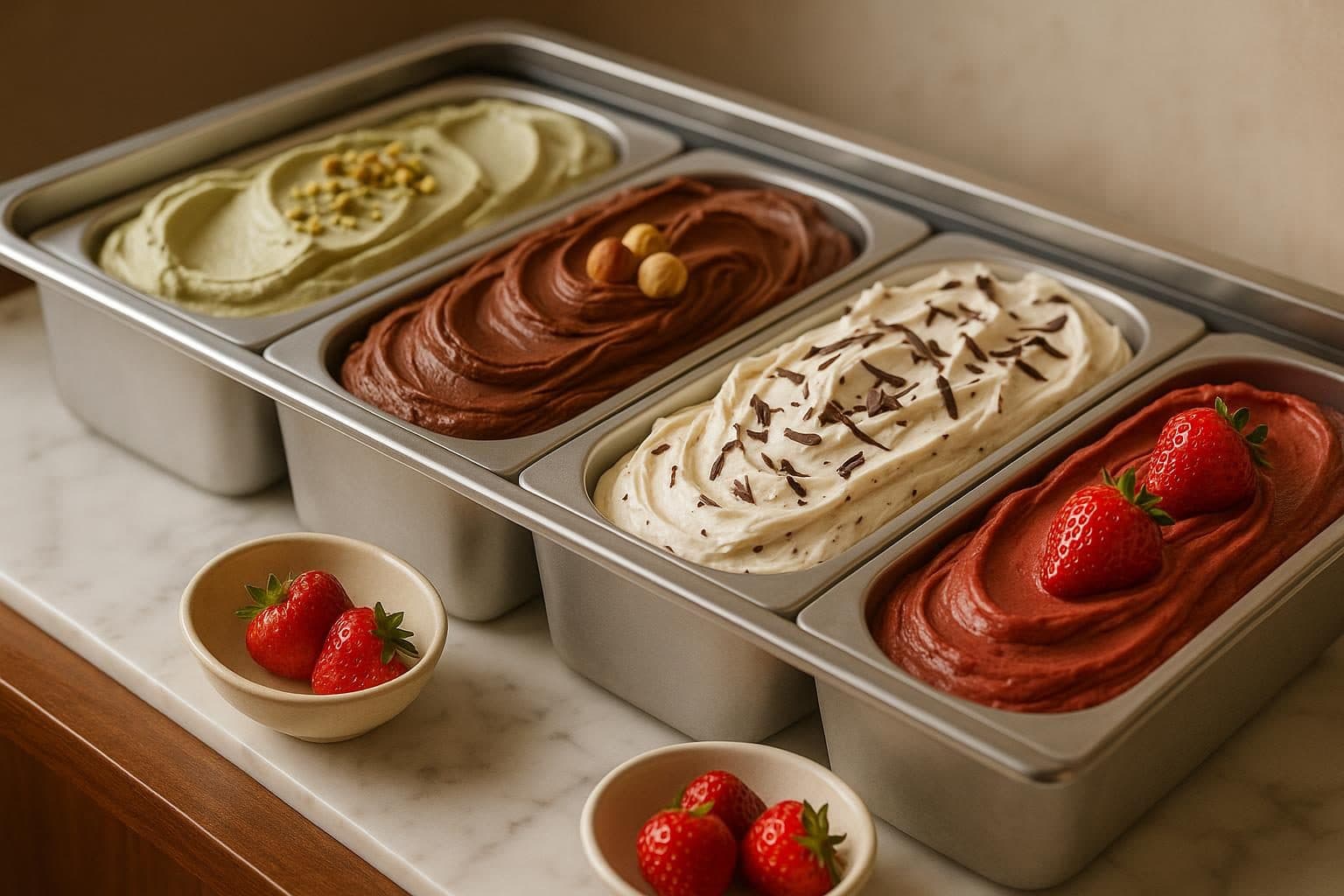
We don't make Mediterranean cuisine, but we believe in the same principles: quality ingredients, seasonality, balance, pleasure without guilt and respect for the process. When we make gelato from fresh raspberries, seasonal peaches or Sicilian pistachio, we follow the logic of the tradition: find the best ingredient at its moment of ripeness and treat it with respect. And when we serve you with a smile and no moralising — because you enjoy a slice of cake without apologising — we follow perhaps the most important Mediterranean lesson: pleasure is an inseparable part of healthy eating.
In the end
The Mediterranean way of eating isn't a diet — it's a civilisation. For millennia these peoples discovered, not through science but through living, what works: variety without prohibition, quality over quantity, the table as ritual, children taught to eat like people, pleasure without guilt.
Science followed with thousands of studies confirming every one of these things. But the truth is that the grandmother in Sardinia never needed the studies — she simply knew. Perhaps we, with our diets, calorie-counting apps and food fads, have lost something very simple: trust in food, in the body and in tradition.
Returning to these principles doesn't require living in Greece; it requires only a little attention — to what you eat, how you eat it and with whom. Health isn't in the diet. It's in the way of life. And the way of life includes the table, the conversation, the laughter and — sometimes — the slice of cake.
- Why do Mediterranean peoples eat carbs and stay slim?
- Because of the whole pattern: quality foods that satisfy faster, plenty of fibre, mindful eating at the table and low food anxiety — not because they avoid particular ingredients.
- Do these principles apply in Bulgaria?
- Yes. Traditional Bulgarian eating has much in common with them — fresh vegetables, legumes, yoghurt and home-cooked food. The principles are universal.
- What is a 'Blue Zone'?
- A region with an exceptionally high concentration of centenarians. Sardinia is one of the world's five — people there eat varied diets, live at the pace of the community and eat without anxiety.